Narrative Economics
Yale University
Taught by Professor Robert J. Shiller
Completed July 2026 · Coursera
Verify certificate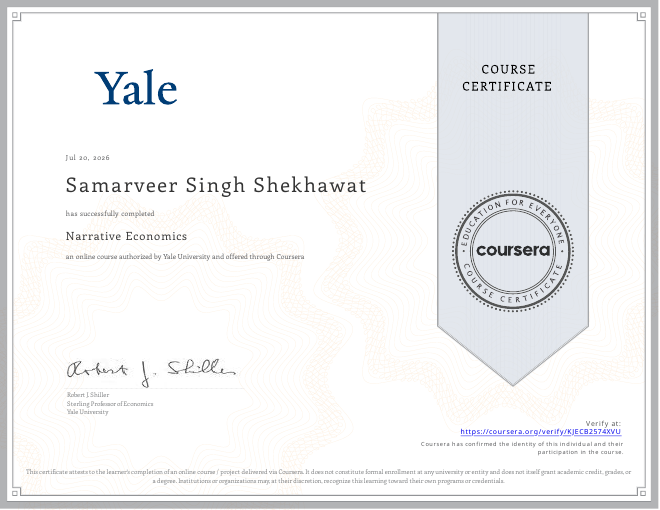
Course Certificate
Yale University · Coursera
ABOUT ME

I grew up in Jaipur surrounded by the legacy of Jaipur Blue Pottery. My great-grandfather, Padma Shri Kripal Singh Shekhawat, devoted his life to reviving and developing the craft, and the conversations, objects and stories that came with that inheritance shaped the way I see my city — as a place where art, livelihoods and history are inseparable.
As an International Baccalaureate Diploma Programme student at Jayshree Periwal International School, I have tried to turn that familiarity into understanding. I study the economics behind traditional industries: why skilled artisans remain on the margins of markets, how they price their work, and how their methods already reflect principles of sustainability that formal frameworks are only beginning to describe.
This curiosity has taken several forms — co-authored research, two books, a heritage-documentation initiative and professional internships. Each has taught me that the most interesting questions in economics are often found in the most familiar places.
My interests begin with markets and widen outwards. Studying how artisans in Jaipur buy raw materials, set prices and sell to tourists led me naturally to behavioural economics, trade and development. Asking why these communities remain informal led me towards public policy, social development and governance. And asking what is lost when a craft declines brought me to cultural economics and sustainability.
Together, these fields form a single line of enquiry: how economic systems can value traditional knowledge fairly and help the communities who hold it to thrive. Select an interest below to see how it connects to my work.
My starting point is the economics of small producers: how artisans organise production, manage costs and reach markets, and why traditional industries so often remain informal. Development economics gives me a framework for asking how these livelihoods can become more secure.
See my research
Both of my books began as independent enquiries — gathering archival material, family records and published sources on Jaipur Blue Pottery and assembling them into coherent narratives.
Ideas such as circularity and willingness to pay became meaningful to me only when I tested them in artisan workshops and through a consumer survey in Jaipur.
My work draws on economics, environmental science, history and art. Co-authoring with a mentor from environmental science showed me how much a problem changes when it is seen from a second discipline.
Internships in consulting and logistics allowed me to see how research is used: as concise notes that inform decisions, and as information that keeps goods moving across borders.
Research has taught me to separate what the evidence shows from what it merely suggests — for example, distinguishing a stated willingness to pay from actual purchasing behaviour.
Karigar is a collaborative effort. Working with others on field documentation, the digital archive and an exhibition taught me as much about coordination as about crafts.
Research & Information Analysis
Secondary research, interviews and structured observation.
Academic Writing & Documentation
Two co-authored research chapters and two books.
Data Collection & Interpretation
Artisan interviews, workshop observation and a 100-respondent survey.
Project Development & Coordination
Building Karigar's digital platform and archive.
Communication & Collaboration
Work with co-authors, mentors, artisans and professional teams.
Critical & Interdisciplinary Thinking
Bringing economics, history and sustainability together.
Leadership & Teamwork
Co-founding Karigar and contributing to its exhibition.
Fieldwork & Community Engagement
Documenting artisans and interviewing craftspeople in their workshops.
Yale University
Taught by Professor Robert J. Shiller
Completed July 2026 · Coursera
Verify certificateCourse Certificate
Yale University · Coursera
University of Pennsylvania
Taught by Professor Rebecca M. Stein
Completed July 2026 · Coursera
Verify certificate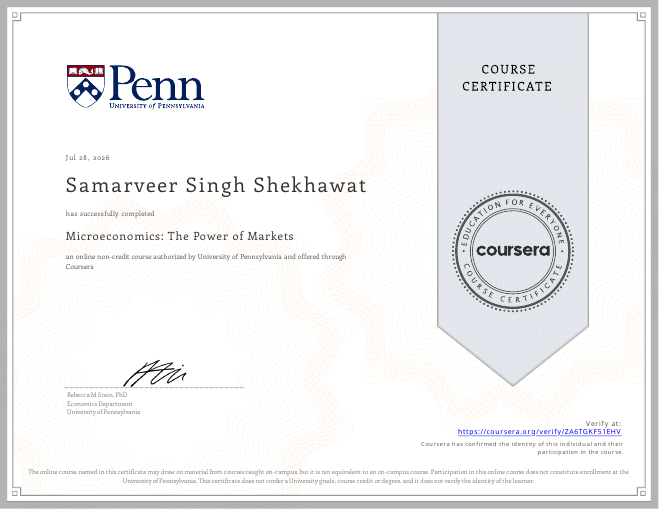
Course Certificate
University of Pennsylvania · Coursera
I am always glad to hear from fellow students, researchers and practitioners.
Write to samarveer.shekhawat@gmail.com