Research I · Published
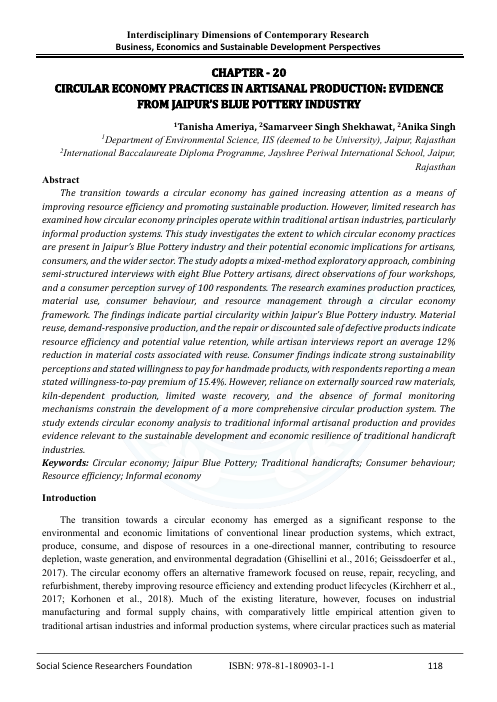
“Circular Economy Practices in Artisanal Production: Evidence from Jaipur's Blue Pottery Industry”
- Role
- Co-author
- Authors
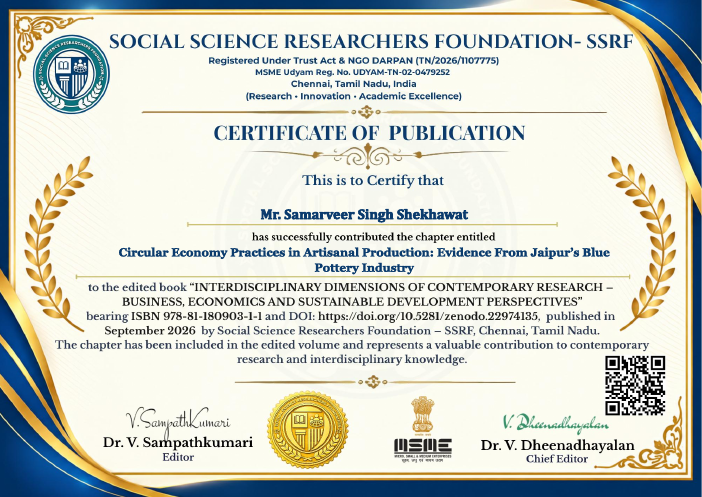
- Tanisha Ameriya, Samarveer Singh Shekhawat, Anika Singh
- Research period
- November 2025 onwards
- Publication
- September 2026
- Publisher
- Social Science Researchers Foundation (SSRF)
- Edited volume
- Interdisciplinary Dimensions of Contemporary Research: Business, Economics and Sustainable Development Perspectives
- ISBN
- 978-81-180903-1-1
- Mentorship
- Tanisha Ameriya, Department of Environmental Science, IIS (deemed to be University), Jaipur
Research Background
The circular economy offers an alternative to the linear model of extracting, producing, consuming and discarding resources, emphasising reuse, repair, recycling and longer product lifecycles. Most of the literature, however, concentrates on industrial manufacturing and formal supply chains. Far less attention has been paid to traditional artisan industries and informal production, where practices such as material conservation and repair may exist without ever being recognised as “circular”.
Jaipur's Blue Pottery is a particularly suitable case. Revived in the city during the twentieth century, it uses a quartz-based composition rather than clay and is made through skilled, predominantly handmade techniques in small workshops. The study asked how these small-scale artisans manage raw materials, production waste, material reuse and resource efficiency — and what those practices might mean economically for artisans, consumers and the wider sector.
Objectives
The research set out to establish the extent to which circular economy principles are reflected in Jaipur's Blue Pottery industry, with particular attention to resource use, production efficiency, material recovery, repair practices and consumer behaviour, and to examine their potential economic implications.
Methodology
The study adopted a mixed-method exploratory case study design, combining qualitative evidence from producers with descriptive quantitative evidence from consumers. Primary data were collected between November 2025 and February 2026.
- Semi-structured interviews with eight artisans, selected through purposive sampling, covering material use, reuse, defect handling, repair, production patterns and waste management.
- Direct observations across four workshops — workshop–showroom units in different locations — focusing on production processes, material handling and resource management.
- A consumer survey of 100 respondents examining sustainability perceptions, stated willingness to pay for handmade products, attitudes towards repair and the factors influencing purchases.
Interview and observational evidence were analysed thematically, survey responses were analysed descriptively, and the three sources were then triangulated to identify where producer and consumer perspectives converged or diverged.
Findings
The evidence pointed to partial and largely informal circularity. The clearest circular characteristic was material reuse, which all eight artisans reported and which was observed in all four workshops. The principal figures are summarised below.
| Measure | Finding | |
|---|---|---|
| Average production batch | ≈ 250 pieces | Typical number of pieces produced per batch. |
| Average selling price | ≈ ₹5,500 per item | Average price at which items were sold. |
| Average raw-material cost | ≈ ₹11,250 per batch | Artisan-reported raw-material expenditure per batch. |
| Unused material after production | ≈ 8% | Share of material left over once a batch is complete. |
| Share of unused material reused | ≈ 85% | Proportion of that leftover material returned to production. |
| Reported saving from reuse | ≈ 12% (≈ ₹1,350 per batch) | Artisan-reported reduction in material expenditure. |
| Consumers willing to pay more for handmade | 80% | Stated willingness, from 100 survey respondents. |
| Average stated premium | 15.4% | Mean premium among respondents willing to pay more. |
Beyond reuse, artisans described other forms of value retention: defective pieces were repaired, sold at a discount or kept as design and colour references, and most production was reported to respond to demand rather than to speculative stock. These practices appeared to be motivated as much by the need to control costs and use resources efficiently as by environmental intent — circularity, in other words, often arose from economic necessity.
On the consumer side, 80% of respondents stated that they would pay more for handmade products, and those willing to do so reported an average premium of 15.4%. It is important to read this carefully: these are stated preferences, not observed purchases, and a willingness to pay does not guarantee that higher prices are realised. Likewise, the reported material savings should not be interpreted as an increase in profit or artisan income, since complete costs and revenues were not measured.
The study also identified clear limits to circularity: reliance on externally sourced raw materials, kiln-dependent production, limited waste recovery and the absence of formal monitoring. Given the small, cross-sectional and self-reported sample, the findings are exploratory.
Significance
The research extends circular economy analysis to traditional, informal artisanal production — a setting the literature has largely overlooked. It shows that sustainable practices already exist within the craft, and suggests that better resource monitoring, kiln efficiency, artisan training and market support could strengthen them further.
My Contribution
As a co-author, I contributed to the study's fieldwork with artisans and consumers, to the analysis of the evidence and to the writing of the chapter, under the mentorship of Tanisha Ameriya.